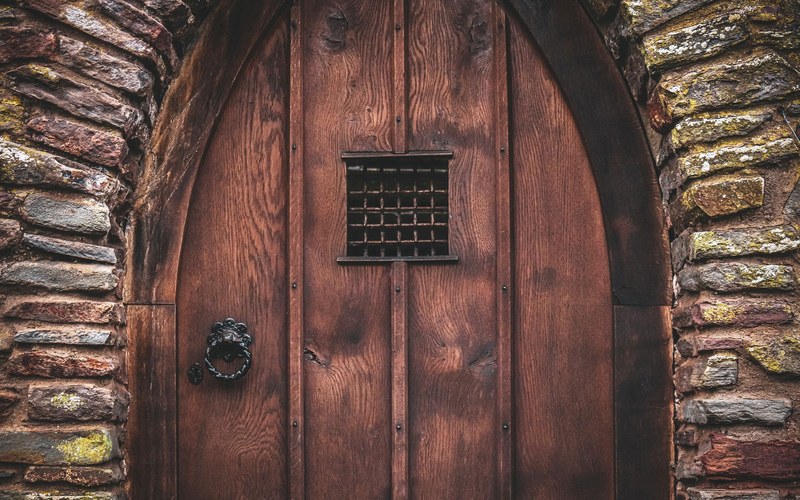
A closed-door romance is a love story that keeps sex off the page. The couple may well end up in bed, and the book may make that clear, but the reader stays in the hallway.
That's the short answer. It comes up more often than you'd think, because the words around it are a mess. Closed door, sweet, clean, wholesome, fade to black, mostly closed door, low spice. A reader trying to find a certain kind of book has to learn a small dialect first. And with the biggest romantasy of the year out last week, and its sexual content being argued over along with everything else, it's a good time to lay out what the terms mean.
I have a stake in this. Every book I write is closed door, and my books are shelved under Clean & Wholesome on Amazon. So here's what the label means, as far as I can tell, and what it doesn't.
What closed door means
Book Riot's explainer gives about the cleanest definition I've found: a closed-door romance has a happy or happy-for-now ending and no sex on the page. Intimate moments happen off the page, and the scene often ends with a "fade to black." The rest is the same as any other romance. There are two people, the book is about them falling in love, and it ends well.
The door is the metaphor. The couple goes through it, and it shuts behind them, and the next thing you know it's morning. Some books don't even get that far. Their couples never go through any door, and the love story ends at a kiss or a proposal. Those usually get filed as closed door anyway, because the term has become the catch-all.
Yes, there can be kissing. Most closed-door romances have some. A lot of them have a great deal of longing. That's rather the point.
Closed door vs. open door
An open-door romance shows the sex on the page. Book Riot suggests a simple working rule: once a scene like that appears, the book is open door. Anything in between can be called "mostly closed door," which covers the book with one short scene or a door that stays open for a page and then swings shut.
The difference has nothing to do with how good the book is, or how much the couple wants each other. Open-door romance can be slow and aching, and closed-door romance can be full of heat. The label only tells you where the camera goes.
Closed door, sweet and clean
Here's where it gets tangled.
"Sweet" usually means low heat, and in the current vocabulary of romance marketing it tends to signal closed door, in the same way that "spicy" signals explicit. Some readers also expect a sweet romance to be gentle in tone, which a closed-door book doesn't have to be. A closed-door romance can have a body in the harbor.
"Clean" is the disputed one. Many readers and writers dislike it, for a reason Book Riot has laid out: if these books are clean, what does that make the others? The word can imply that romance with sex is dirty, and plenty of people who love both kinds of book don't care for that. "Wholesome" sometimes also signals faith content, or the absence of swearing, which goes beyond the bedroom.
I understand the objection. I also know that "Clean & Wholesome" is the name of the category readers look under on Amazon, so that's where my books sit. For the record, I don't think there's anything unclean about a good love scene. I just write the kind where the door shuts. "Closed door" is the phrase I'd pick, because it says what happens and passes no judgment on anyone else's bookshelf.
What the closed door does for a story
When you can't pay off the tension on the page, you have to build it everywhere else.
That sounds like a restriction, and it is one, in the way that a sonnet is a restriction. It pushes the charge into smaller places. A glance across a crowded room. Two hands on the same page of a ledger. A name said for the first time without the title in front of it. Rachel McMillan, writing about the rise of closed-door romance for Writer's Digest, points to classic novels where a shared blanket or a lingering scent carries real romantic weight. Readers of Austen have been holding their breath over a hand helping someone into a carriage for two hundred years.
It also leaves room for the reader. A closed door doesn't tell you what happened. It tells you something did, and it lets you bring your own imagination to the rest. For some readers that's more intimate, and for others it's simply more comfortable. Either reason is fine.
And it fits a slow burn. In a closed-door book, the love story has to be carried by what the two people say and do for each other. So the writer has to get the trust right, because there's no other way to prove the romance.
What it doesn't mean
A few things the label does not promise.
It doesn't mean the book is religious. Some are, many aren't.
It doesn't mean the stakes are low. My books have framed men, forged papers and people with real power who want those papers buried. Closed door describes one kind of scene. It says nothing about the rest of the plot, and you should still check for violence or grief if those matter to you.
It doesn't mean the characters don't want each other. In a good one, they want each other on every page.
It doesn't mean a young adult book. These are adult love stories about adult problems, and the people in them are often tired, in debt and carrying a past.
And it isn't a verdict on anyone else's reading. Moderators of the r/RomanceBooks community said as much back in 2023, when they promised to remove posts that shamed closed-door readers. The opposite should hold as well. Read what you like.
How to check a book before you buy
The labels are inconsistent, so a little detective work helps.
- Look at the category. On Amazon, Clean & Wholesome is the obvious shelf. It isn't perfectly policed, so treat it as a first filter.
- Read the reviews for the word. Search a book's reviews for "closed door" or "fade to black." Readers who care will usually say so.
- Check Romance.io. Its steam rating is widely used, and closed-door books generally sit at the low end of the scale.
- Look at the author's site. Many closed-door authors say so up front, because it's a selling point for the readers they want.
- Read the sample of a later book. Heat policies tend to run through an author's list, though not always. If a writer goes open door in one series, check before you assume the next book matches.
Closed-door historical romance to start with
Historical romance is a natural home for the closed door, since the rules of the time make every touch matter. Here are some places to begin.
Georgette Heyer. The obvious starting point. Venetia and These Old Shades are funny, sharp and closed door, and she invented half of what the subgenre still does.
Jane Austen. Yes, she counts. Persuasion is the great second-chance romance, and it's built entirely on looks, letters and restraint.
Elizabeth Gaskell. North and South gives you class tension, a mill owner and one of the best slow burns in English.
Mimi Matthews. A modern bestselling author of closed-door historical romance, and the one McMillan's Writer's Digest piece reaches for as proof that a fade to black can hit as hard as anything explicit.
Carla Kelly. A long list of quiet, adult love stories, many of them about working people and soldiers.
Suzanne Allain. Mr. Malcolm's List is the one most readers know. It's light and very funny.
The Harbor of Secrets. I'd be a poor shopkeeper if I left this one out. It's atmospheric harbor romance set in 1830s New England, closed door, with a happy ending in every book. The Smuggler's Ledger and The Proprietor's Bargain are both in Kindle Unlimited, and you can read them in either order. Ink & Saltwater, Book 3, arrives December 1. You can see the cover here.
The short version
Closed door tells you where the camera stops. It doesn't tell you how much the book will hurt, how high the stakes run or how badly those two people want each other. If you've been told you must not like romance because you skip the sex scenes, you've been told wrong. There's a very long shelf waiting for you, and much of it is older than the word "spicy."